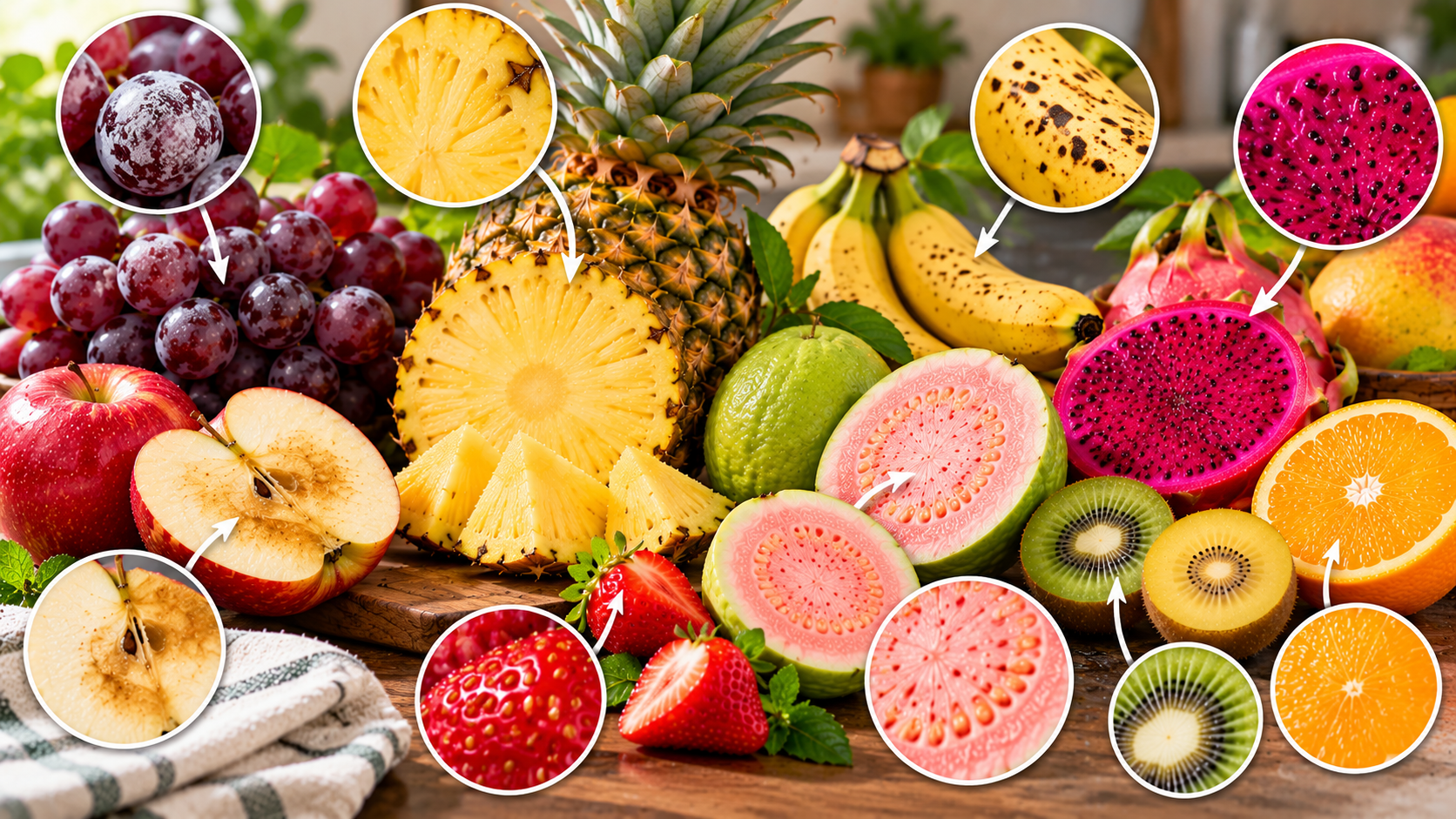
You take a bite of fresh pineapple. It's delicious, sweet and juicy.
Then something strange happens.
Your tongue starts tingling.
A few minutes later, you're looking at a bunch of grapes covered in mysterious white powder. You wonder whether it's safe to eat.
Meanwhile, the apple you sliced earlier has turned brown, and the banana you put in the refrigerator yesterday now has an almost black peel.
What's going on?
Believe it or not, your fruit bowl is full of fascinating science.
Some fruits contain protein-breaking enzymes. Others produce their own protective wax. Some change colour because they react with oxygen, while others hide surprising secrets about how they grow.
And the strangest part? Many of these things are completely natural.
Here are eight fascinating fruit mysteries explained by science—including facts that might change the way you look at your next fruit basket.
The 8 Fruit Mysteries at a Glance
| Fruit mystery | What's actually happening? |
|---|---|
| Why pineapple tingles your tongue | Enzymes, acidity and possibly tiny crystals |
| Why grapes look dusty | A natural protective wax called bloom |
| Why sliced apples turn brown | Enzymes react with oxygen |
| Why banana peels darken in the fridge | Cold-temperature injury and ripening changes |
| Why dragon fruit is so pink | Naturally occurring pigments called betalains |
| Why strawberries have "seeds" outside | The tiny specks are individual botanical fruits |
| Why seedless watermelons exist | Special plant breeding produces sterile triploid plants |
| Why some ripe oranges are green | Peel colour and internal maturity develop differently |
Now for the interesting details.
1. Why Does Pineapple Make Your Tongue Tingle?
Have you ever enjoyed a few pieces of pineapple, only to feel as though your tongue has been lightly scratched?
There's some fascinating chemistry behind that sensation.
The science behind the tingle
Pineapple contains bromelain, a group of enzymes that break down proteins.
These enzymes are one reason pineapple has been used in meat-tenderising preparations.
But the inside of your mouth also contains proteins.
Researchers believe bromelain, together with pineapple's natural acidity and possibly microscopic needle-like calcium oxalate crystals, can contribute to the tingling or irritating sensation some people experience.
The exact contribution of each factor isn't completely established.
Does that mean pineapple is dangerous?
Not necessarily.
A mild, short-lived tingling sensation after eating fresh pineapple can be ordinary irritation.
But not every mouth reaction should be dismissed.
If you experience significant swelling, hives, breathing difficulty or another severe reaction, stop eating and seek appropriate medical care. Such symptoms may indicate an allergic reaction.
Can you reduce the tingling?
Heating pineapple can reduce bromelain activity.
That's one reason grilled or cooked pineapple may feel different from fresh pineapple.
Fun food fact: The same protein-breaking enzyme explains why fresh pineapple can interfere with gelatin desserts setting properly.
Heat-treated pineapple is less likely to create that problem.
Try it with Tokriii: Explore fresh and tropical fruits, including pineapple when available.
2. What's That White Powder on Grapes? Is It a Chemical?
Imagine opening a box of beautiful green or black grapes.
You notice a thin, cloudy white coating on some of the grapes.
Your first thought might be:
"Is this pesticide?"
Here's the surprising answer.
Grapes can produce their own protective coating
Many grapes develop a natural waxy surface layer called bloom.
This fine coating helps reduce moisture loss and provides some protection to the fruit's surface.
It can look like a pale, dusty film.
Bloom is particularly noticeable on dark grapes and blueberries.
Is grape bloom safe?
The natural waxy bloom itself is generally harmless.
However, an important distinction matters.
Not every white substance on grapes is necessarily bloom.
Grapes can also become contaminated, mouldy or damaged.
If you see unusual fuzzy growth, obvious mould, leaking fruit or signs of decay, don't assume the coating is natural.
Should you wash grapes?
Yes.
Rinse grapes gently under clean running water before eating.
You don't need detergent or commercial produce wash.
Interesting fact: The pale bloom can rub away during handling, so its presence or absence isn't a perfect freshness test.
Tokriii pick: Explore fresh grapes and premium grape varieties, including Red Globe and Shine Muscat when available.
3. Why Does a Freshly Cut Apple Turn Brown?
You cut a crisp, beautiful apple.
The slices look fresh and pale.
You leave them on a plate while preparing breakfast.
When you return, the exposed surfaces have turned brown.
Did the apple go bad in just a few minutes?
Usually, no.
Meet enzymatic browning
Apples contain naturally occurring compounds and enzymes, including polyphenol oxidase.
When you cut or bruise an apple, its cells become damaged.
Oxygen from the air can then interact with these substances, triggering chemical reactions that produce brown pigments.
This process is called enzymatic browning.
Similar reactions can occur in pears, avocados and some other fruits.
Is a slightly brown apple unsafe to eat?
Browning caused by oxidation doesn't automatically mean the apple has spoiled.
However, colour alone cannot confirm food safety.
A cut apple that has been stored improperly, developed mould or shows other spoilage signs should not be eaten.
How can you slow apple browning?
A little lemon juice can help slow the browning process.
Its acidity and antioxidant components interfere with the reactions responsible for colour changes.
You can also reduce unnecessary exposure to air and refrigerate cut fruit promptly.
Try this: Prepare a simple fruit bowl with crisp apple cubes, pomegranate arils and a little lemon juice.
Tokriii pick: Browse premium apple varieties, including Gala, Pink Lady and other selections when available.
4. Why Do Bananas Turn Black in the Refrigerator?
You've probably experienced this.
You buy a bunch of bananas.
They're perfectly yellow.
You put a few in the refrigerator because you want them to stay fresh.
The next day, the peel looks much darker.
Did refrigeration ruin the bananas?
The answer depends on how ripe they were and how they were stored.
Bananas don't always like the cold
Bananas are tropical fruits.
They can be sensitive to low temperatures, particularly before they are fully ripe.
Cold exposure can disrupt normal processes in the peel and produce dark discoloration.
This is known as chilling injury.
It may also interfere with normal ripening in bananas that were still green.
Does a black peel mean the banana is rotten?
Not automatically.
A fully ripe banana may develop a much darker peel in the refrigerator while its flesh remains acceptable.
But if the flesh is leaking, mouldy, rotten or has an unusual smell, it should be discarded.
What's the practical lesson?
Allow mature, green bananas to ripen at an appropriate room temperature.
Once fully ripe, refrigeration can help slow further softening for a short period, although the peel may darken.
Fun fact: Bananas are climacteric fruits, meaning their ripening is associated with a rise in respiration and the plant hormone ethylene.
That's why appropriately mature green bananas can continue ripening after harvest.
5. Why Does Red Dragon Fruit Look Almost Artificially Pink?
If you've ever sliced a red-fleshed dragon fruit, you know how dramatic the colour can be.
The flesh may be such a vivid pink or purple-red that it almost looks artificially coloured.
Sometimes the pigment even transfers to your fingers or chopping board.
But there's an entirely natural explanation.
The secret is plant pigments
Red-fleshed dragon fruit contains natural pigments known as betalains, including red-purple compounds called betacyanins.
These pigments are responsible for much of the fruit's distinctive colour.
They are also found in certain other plants, including beetroot.
Why is some dragon fruit white inside?
Different dragon fruit varieties have different pigment compositions.
White-fleshed dragon fruit contains far less of the red-purple pigmentation found in red-fleshed varieties.
Both can be delicious.
And here's an important detail:
A brighter red dragon fruit isn't automatically sweeter than a white one.
Flavour depends on variety, maturity and growing conditions.
A fun experiment for your next fruit platter
Cut red and white dragon fruit into similarly sized cubes.
Arrange them in alternating colours alongside slices of golden kiwi.
You'll create a dramatic-looking platter using natural fruit colours.
Tokriii pick: Explore premium and exotic fruits, including red and white dragon fruit options.
6. Why Are Strawberry "Seeds" on the Outside?
Here's a fact that sounds almost made up.
The tiny specks scattered across the outside of a strawberry aren't actually naked seeds.
Botanically, they're individual fruits.
Wait, what?
The small seed-like structures are called achenes.
Each achene is a tiny, dry botanical fruit containing a seed.
The large, juicy red part we enjoy is primarily an enlarged flower structure called the receptacle.
So the strawberry we eat is botanically quite different from what most people imagine when they hear the word "berry."
Is a strawberry a true berry?
Not in the strict botanical sense.
Strawberries are classified as accessory aggregate fruits rather than true berries.
And here's another surprise:
A banana is considered a berry in botanical classification, but a strawberry isn't.
Everyday food names and botanical classifications don't always match.
Why does this matter?
It probably won't change how you eat strawberries.
But it makes a great conversation starter.
Try asking a friend:
"Which of these is technically a berry: banana or strawberry?"
You might be surprised by the answers.
7. Are Seedless Watermelons Genetically Modified?
This is one of the most interesting fruit questions.
You cut into a beautiful watermelon.
The flesh is juicy and sweet, but there are no familiar hard black seeds.
How is that possible?
The surprising science of seedless watermelon
Many commercially grown seedless watermelons are produced through conventional plant breeding involving different chromosome numbers.
A typical watermelon plant has two sets of chromosomes.
Breeders can cross plants with two sets and four sets to produce offspring with three sets.
These are called triploid watermelons.
Triploid plants generally cannot produce fully developed, mature seeds in the usual way.
The resulting fruit may contain small, soft, white, undeveloped seed structures rather than hard black seeds.
Does that mean seedless watermelon is genetically engineered?
Not necessarily.
The established triploid seedless-watermelon method uses plant breeding and chromosome manipulation rather than introducing foreign genes through genetic engineering.
In other words, seedless watermelon doesn't require genetic engineering to be seedless.
Does being seedless make watermelon less nutritious?
Seedlessness alone doesn't establish whether one watermelon is healthier than another.
Nutritional quality depends on the variety, growing conditions and other factors.
The simplest reason people like seedless watermelon is convenience.
A fun family question
Ask everyone at home:
"Do you think a watermelon can grow without producing mature black seeds?"
Then share the answer.
You might just turn a simple afternoon snack into an interesting little science lesson.
8. Why Are Some Ripe Oranges Still Green?
An orange should be orange, right?
Not always.
Some citrus fruits can be mature and ready to eat even while parts of their peel remain green.
And here's the interesting reason.
Peel colour and internal maturity are different things
The outside colour of citrus fruit is influenced by pigments, particularly chlorophyll and carotenoids.
Chlorophyll contributes green colour.
Carotenoids contribute yellow and orange shades.
As many citrus fruits mature, the balance of these pigments changes.
However, weather conditions, especially temperature, can affect how quickly the peel loses its green colour.
Can an orange be ripe while its skin is green?
Yes, depending on the variety and growing conditions.
The fruit may have reached an acceptable eating maturity even though part of the peel remains greenish.
Commercial citrus producers sometimes use a controlled process called degreening to improve peel colour.
This changes the appearance of the fruit but does not necessarily make the interior sweeter.
Does that mean every green orange is ripe?
No.
A green peel isn't proof of ripeness either.
Different citrus fruits have different maturity characteristics.
The important lesson is that appearance alone does not tell the whole story.
Tokriii pick: Explore imported fruits and citrus selections, subject to seasonal availability.
The Fruit Science Quiz: How Many Did You Know?
Now that you've read the explanations, test your knowledge.
Question 1: Which fruit contains an enzyme that can break down proteins?
Answer: Pineapple.
Question 2: What's the natural white coating on many grapes called?
Answer: Bloom.
Question 3: What causes freshly cut apples to turn brown?
Answer: Enzyme-driven reactions involving oxygen.
Question 4: Can banana peels turn dark because of refrigeration?
Answer: Yes. Bananas can experience chilling injury.
Question 5: What gives red dragon fruit its striking colour?
Answer: Natural pigments including betacyanins.
Question 6: Are the tiny specks on a strawberry actually individual botanical fruits?
Answer: Yes. They're called achenes.
Question 7: Do seedless watermelons have to be genetically engineered?
Answer: No. Conventional plant-breeding techniques can produce them.
Question 8: Can an orange be ripe while some of its peel is still green?
Answer: Yes, depending on variety and growing conditions.
Your score
7–8 correct: You're a fruit-science expert!
4–6 correct: You know more than most casual fruit shoppers.
0–3 correct: You've just discovered eight fascinating things about everyday food.
Share this quiz with someone who loves fruits and see whether they can beat your score.
When Is a Strange Fruit Appearance Normal—and When Should You Be Careful?
Understanding fruit science can help you avoid unnecessary food waste.
But there's an important difference between a natural appearance change and genuine spoilage.
Here's a quick guide.
| What you notice | What it might mean |
|---|---|
| Light brown surface on a freshly cut apple | Normal enzymatic browning |
| Thin, even white bloom on grapes | Natural protective wax |
| Dark banana peel after refrigeration | Ripening or chilling-related discoloration |
| Intense pink dragon fruit flesh | Natural pigments |
| Fuzzy mould, leaking flesh or rotten smell | Possible spoilage; don't eat |
These are general clues, not a substitute for checking food safety.
A fruit can carry harmful microorganisms without visible signs of spoilage.
Always wash produce appropriately, use clean utensils and refrigerate cut fruit promptly.
If fruit looks rotten or mouldy, discard it.
Three Fun Ways to Explore Fruit Science at Home
Want to make these discoveries more memorable?
Try these simple food activities.
Experiment 1: The Apple Browning Test
Take one washed apple and cut it into equally sized pieces using a clean knife.
Leave one piece untreated.
Add a little lemon juice to another.
Observe how the exposed surfaces change colour over a short period.
You may notice the lemon-treated apple browns more slowly.
Don't leave the prepared fruit out for extended periods, and discard the pieces after the experiment rather than treating them as food for later.
Experiment 2: The Natural Fruit Colour Platter
Arrange red dragon fruit, white dragon fruit, kiwi and orange segments on a plate.
Notice how dramatically the colours differ.
Each colour comes from naturally occurring pigments and fruit structures.
Serve the freshly prepared platter promptly or keep it refrigerated until serving.
Experiment 3: The Grape Bloom Observation
Before washing a bunch of sound, fresh grapes, look closely at their surfaces.
Notice whether they have a delicate pale coating.
Gently rub one grape and compare the appearance with an untouched one.
Then rinse the grapes thoroughly under running water before eating.
Remember that visible bloom alone does not establish whether produce is clean or safe.
Frequently Asked Questions About Strange Fruit Facts
Why does pineapple make your mouth itchy or tingly?
Pineapple contains bromelain, natural acids and microscopic calcium oxalate crystals that may contribute to irritation. Severe swelling, breathing problems or persistent reactions require medical attention.
Is the white powder on grapes pesticide?
The common thin, pale coating is often a naturally occurring wax called bloom. However, appearance alone cannot rule out contamination or mould. Wash grapes before eating and discard spoiled produce.
Are brown apple slices safe to eat?
Brown colour caused by enzymatic oxidation doesn't automatically mean spoilage. However, food safety still depends on handling, refrigeration and the absence of contamination or decay.
Why does a banana turn black in the refrigerator?
Bananas are sensitive to cold temperatures. Refrigeration can cause peel discoloration, especially in unripe fruit. A dark peel doesn't always mean the flesh has spoiled.
Is red dragon fruit artificially coloured?
The colour of naturally red-fleshed dragon fruit comes largely from plant pigments called betalains. Different varieties naturally have different flesh colours.
Are strawberries really berries?
Not in strict botanical classification. The fleshy strawberry is an accessory aggregate fruit, and its tiny outer specks are achenes containing seeds.
Is seedless watermelon genetically modified?
Conventional seedless watermelon varieties are commonly produced through breeding triploid plants. This process doesn't require the genetic-engineering methods usually associated with genetically modified crops.
Can green oranges be sweet?
Yes. Some citrus fruits reach eating maturity before their peels completely lose their green colour. However, green skin alone doesn't guarantee maturity or sweetness.
Every Fruit Has a Story
The next time you pick up a pineapple, take a closer look.
That sweet tropical fruit contains enzymes capable of breaking down proteins.
The grapes beside it may be wearing their own protective wax.
The banana on your counter is changing as it ripens.
And the bright red dragon fruit might contain natural pigments vibrant enough to colour your chopping board.
The more you understand fruits, the more interesting they become.
They're not just ingredients for a smoothie or pieces in a fruit bowl.
They're remarkable products of nature, filled with fascinating chemistry, surprising structures and extraordinary variety.
Explore the Wonderful World of Fruits with Tokriii
At Tokriii, we bring together familiar Indian favourites, seasonal fruits, premium selections and exotic varieties.
From fresh apples, bananas and pineapple to dragon fruit, kiwi, grapes and more, there's always something interesting to explore.
Whether you're preparing a colourful fruit platter or introducing your family to a new variety, start with fruit you enjoy and discover something different.
Discover Exotic & Tropical Fruits
Visit Tokriii.com to see current products, pack sizes and delivery availability.
And before you go, here's one final question:
Which fruit fact surprised you the most?
The pineapple that makes your tongue tingle?
The protective wax on grapes?
Or the fact that strawberries aren't technically berries?
Share your favourite surprising fruit fact with someone who loves food.
Because the next great food conversation might start with something as simple as a piece of fruit.
Research & Further Reading
This article was developed using science and food-safety information from:
-
McGill University — Why Does Pineapple Make Your Mouth Tickle?
-
Penn State Extension — Preserving Colour and Preventing Browning
This article provides general food-science education. Natural colour changes and other visible characteristics are not guarantees of food safety, ripeness or product quality.